Doing good while reading good — join the Nonprofit Good News-Letter.
Challenge 43 in the series 50 Reasons Why It Is Hard to Run a Nonprofit
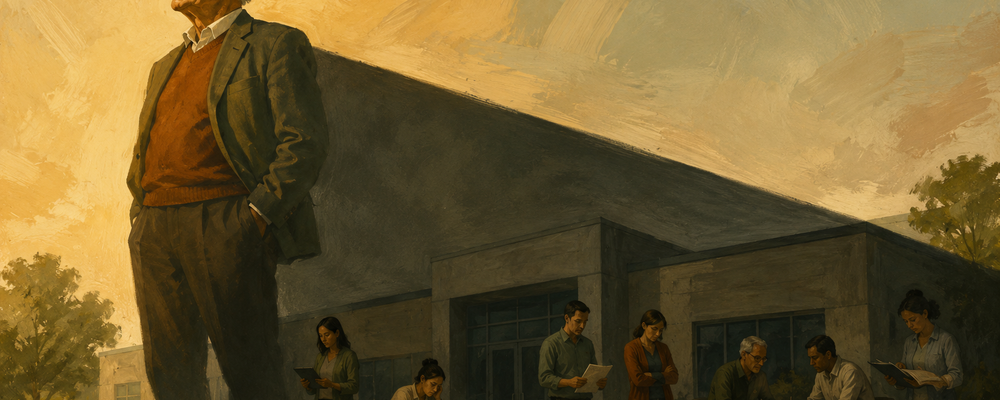
He built the organization from nothing. He wrote the first grant on her kitchen table. He recruited the first board members from his personal network. He was the executive director, the fundraiser, the program director, and the volunteer coordinator — simultaneously — for the first three years.
Twenty years later, he's still all of those things. The board he recruited doesn't challenge him. The staff he hired report to him directly — all of them. There's no succession plan because he can't imagine the organization without him. And he's right — in its current form, it can't exist without him. That's the problem.
The Nonprofit Quarterly calls it one of the most common and most sensitive challenges in nonprofit governance: founder's syndrome, the condition where a founder's identity becomes so fused with the organization that the organization can't function, grow, or transition independently.
The Kellogg School of Management at Northwestern has studied the core dynamic. The same qualities that made the founder successful in the startup phase — decisiveness, personal control, relentless drive — become liabilities as the organization matures and needs distributed leadership, governance oversight, and institutional knowledge that doesn't live in one person's head.
Research from Walden University adds a counterintuitive finding: founder-led nonprofits tend to have smaller budgets than organizations led by non-founders. Passion and personal connections don't automatically translate to organizational growth. Sometimes they constrain it.
I wrote about this in Managing Your Nonprofit for Resilience because I've seen the pattern so many times. The board defers to the founder on every significant decision. Staff route around the org chart and go directly to the founder for approvals. There's no succession plan — and every time someone raises the topic, it gets tabled. Key organizational knowledge — donor relationships, program history, institutional memory — exists only in the founder's head.
If you recognized your organization in that paragraph, you're not alone. And the founder probably isn't reading this post, which tells you something about who needs to act.
The board needs to act because the board is where the dysfunction lives. A functioning board would set expectations for the ED, conduct regular evaluations, require succession planning, and ensure that no single person holds the organization hostage. When a board doesn't do these things for a founder, it's usually because the board was built by the founder, serves at the founder's pleasure, and has never developed the independence to govern.
So the fix starts with one or two board members who recognize the pattern and have the standing to name it.
Start with succession planning. Frame it as organizational resilience, not a referendum on the founder. Every organization needs a succession plan — even if the founder plans to stay for 10 more years. The plan ensures the organization survives the bus test: what happens if the founder gets hit by a bus tomorrow?
Build independent board capacity. Recruit board members who weren't handpicked by the founder. Ensure the board has meeting time without the ED present. Create a governance committee with real authority to evaluate leadership performance.
Distribute institutional knowledge. If the founder is the only person who knows the major donor relationships, the program history, or the financial picture, that's a single point of failure (which I covered in Challenges 14 and 15). Document everything. Cross-train staff. Make the organization's knowledge organizational, not personal.
Create growth opportunities for the founder. Some founders aren't clinging to power — they're stuck because nobody has offered them an alternative. A transition to board chair, to a founder emeritus role, or to a new project within the organization can honor what he built while opening space for new leadership. This is not a suggestion to "Plaque'm and Sack'm." Make the transition real.
Have the conversation. This is the hardest step and the most important one. Someone — a trusted board member, a peer ED, an outside consultant — needs to say what everyone is thinking. Done with respect and genuine appreciation for what the founder built, this conversation can be the beginning of a healthier organization. Done poorly or not at all, the organization remains stuck. The dynamics of founder transitions and the governance structures that support them are subjects I return to regularly in Nonprofit Good News Premium.
If you're a board member at a founder-led organization, ask one question at your next board meeting: "Do we have a written succession plan?" If the answer is no, propose creating one. If the question gets deflected, that reaction is your most important data point.
This is part of an ongoing series based on the 50 challenges outlined in Appendix 1 of Managing Your Nonprofit for Resilience (Wiley, 2023). Each post names one challenge clearly and offers a practical reframe with steps you can take this week. For deeper coverage of nonprofit strategy, risk, and resilience — including tools you can put to work immediately — check out Nonprofit Good News Premium.